The Actual Signal That Predicts Whether a Microtrend Will Have Staying Power or Fade Fast
Deciding whether a specific microtrend is worth investing money in gets judged by how much current buzz and visibility it’s generating, but the actual signal that more reliably predicts whether a given microtrend will have real staying power or fade within a season has considerably more to do with its specific origin-and-spread pattern than with its current buzz level alone.

Why Origin-and-Spread Pattern Genuinely Predicts Lifespan More Reliably Than Current Buzz
A microtrend that originates from and spreads primarily through algorithmically boosted short-form video content tends to peak and fade considerably faster than a microtrend that originates from or gets adopted by established designers and gradually filters into mainstream retail, since the first pattern is genuinely driven by short-attention-span content-cycle dynamics while the second reflects a more considered and typically slower-moving adoption process.

The Concrete Signal Actually Involved
Check specifically whether a given microtrend can be traced back to a runway or established designer collection origin that’s gradually filtering into wider retail, versus whether it seemingly emerged directly from social content virality with no clear designer or runway origin at all — the former pattern genuinely correlates with more staying power, while the latter genuinely correlates with a faster fade.
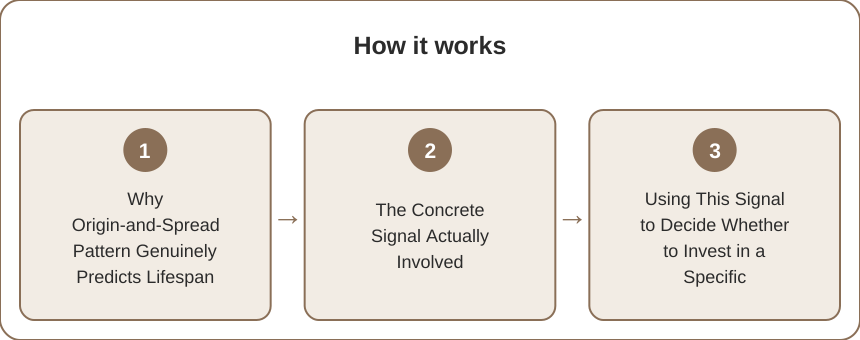
Using This Signal to Decide Whether to Invest in a Specific Microtrend
Before spending meaningfully on a specific emerging microtrend, trace its actual origin back as far as it’s traceable, and treat a genuine designer-runway origin as a green light for a more meaningful investment, while treating a purely social-content-driven origin with no traceable designer origin as a signal to either skip the investment or keep spending genuinely minimal until the trend proves more staying power over time.
A microtrend’s actual origin-and-spread pattern predicts its likely lifespan more reliably than its current buzz level, since trends originating from and spreading through algorithmically boosted short-form content tend to fade considerably faster than trends originating from an established designer or runway collection that gradually filters into mainstream retail, so tracing a given microtrend’s actual origin back as far as possible before investing meaningfully in it — treating a genuine designer origin as a greenlight and a purely social-content origin as a reason for caution — is a more reliable way to predict staying power than reading current buzz alone.
Keep Reading
This article is for general styling and informational purposes only. Trends, sizing, availability and pricing may vary by brand and season.